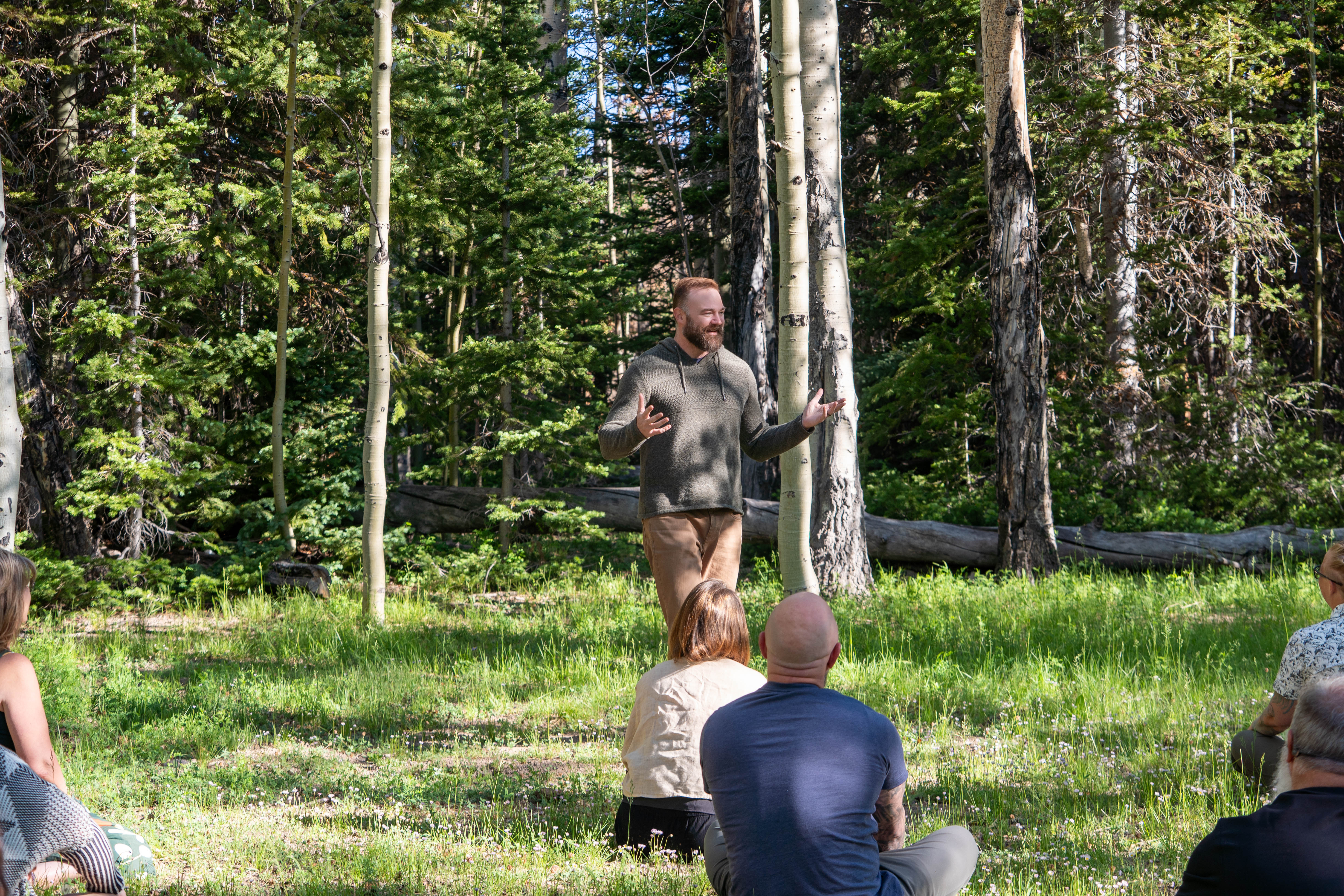
Faculty teaching a seated cohort in an aspen grove during the Language of Breath capstone

Certification

Two tracks. One curriculum. The same credential.

Both paths run the complete Language of Breath system, taught by the same faculty, with a full year of post-graduation support. The difference is whether you travel.

Online Certification

$3,200 · Virtual capstone, 10–24 November 2026

The full curriculum delivered remotely, with live practicums and direct faculty feedback. Same credential as the hybrid track.

  • Live practicums with faculty observation
  • Graded scope-of-practice module
  • Contraindication screening assessment
  • 12 months post-graduation support

Hybrid Certification

$6,200 · Capstone 13–19 June 2027, Brian Head, Utah

Everything in the online track, plus a capstone week of direct facilitation practice with faculty present in the room.

  • Everything in the online track
  • In-person capstone week
  • Direct facilitation practice, observed
  • Professional photoshoot for your practice

What it would cost to assemble this yourself

Most facilitators build competency one disconnected course at a time.

If you wanted to become a genuinely well-rounded facilitator, one who is credible, trauma-informed, scientifically grounded and actually equipped to build a practice, here is the path most people take. A conscious connected breathwork certification from one school. A separate course on CO₂ tolerance, because most CCB programs don’t cover it. Trauma-informed training somewhere else again, because sitting with someone through a hard release is a different skill from teaching a pattern. Then business training, which almost none of them include.

And the piece that ties it together, interoception training grounded in peer-reviewed research, you would most likely not find at all.

Bought separatelyTypical cost
Conscious Connected Breathwork training$2,000 – $5,000
CO₂ tolerance and functional breathing$1,000 – $2,000
Trauma-informed facilitation$500 – $1,500
Breathing mechanics and correctional protocols$500 – $1,500
Business training and practice building$500 – $2,000
Professional photo portfolio$500 – $1,500
5-day live immersive retreat and capstone$1,500 – $3,000
Progressive interoception training, informed by peer-reviewed researchFormal interoception training is scarce and priced accordingly. This figure reflects what comparable clinical-track training costs elsewhere, not a like-for-like equivalent.~$3,000
One year of Residency: weekly Language Labs and monthly professional developmentBenchmarked against group mentorship and supervision programs at $100–300 a month$1,200 – $3,600
Licensed music library for client sessionsBenchmarked against commercial royalty-free music subscriptions$180 – $600
Practice forms: intake, screening and session templates$300 – $1,000
Assembled separately$11,180 – $24,700
The Language of Breath Certification$3,200 online · $6,200 hybrid

This isn’t another single item on that list. It is the whole list, plus a year of Residency while you put it to work, already synthesized into one coherent system, taught by people who spent years combining applied mentorship with the research behind it, instead of stitching together loose techniques from traditions that don’t agree with each other.

Every enrollment is backed by a 100% money-back guarantee. Not because we expect you to need it. Because the value here should hold up under real scrutiny, and we would rather put our own money behind that than ask you to take it on faith.

Included · The Residency

Certification is the start of the year, not the end of it.

Every graduate gets a full year of Residency. Most programs hand you a certificate and wish you luck. The hardest part of this work is the first twelve months of doing it for real, so that is the part we stay for.

01

Weekly Language Labs

The same labs you trained in, every week, for a year. Bring a real client problem and work it through with faculty and peers.

02

Monthly professional development

Ongoing sessions on practice, method and the parts of this work nobody warned you about.

03

The full music catalog

Complete access to the Language of Breath music library for your own sessions, so you are not sourcing tracks or worrying about what you are allowed to play.

04

Forms and digital resources

Intake forms, screening documents and session materials. The paperwork that makes a practice defensible, already built.

05

A community that answers

Practitioners who were where you are last year. When a session goes somewhere unexpected, there are people to ask the same evening.

A full Language of Breath session in progress, participants working on mats

Live practicums run at full cohort scale, with faculty in the room

How the training actually runs

Self-paced, but never on your own.

Twenty modules you work through at your own speed. Most people take a few months. Some move faster, some slower, and neither is a problem, because the pace is yours to set around a job and a life.

What does not change is that the entire time you are working through them, you have weekly Language Labs, monthly professional development sessions, and direct access to faculty. Most online certifications mean something else by self-paced. They mean here are the videos, good luck. You can do this one in the evenings and still be in a room with faculty every week.

Phase one · a few months

The coursework

Twenty modules at your own pace, with weekly labs and monthly professional development running alongside from the first week. You are never working through the material in isolation.

Phase two · one to two weeks

The capstone

Online or in person at Brian Head. Observed facilitation practice, assessed against the same criteria either way. This is where the material stops being theory.

Phase three · a full year

The Residency

Twelve months of continued support once you are certified and working with real clients. The labs and development sessions carry straight on.

And then most people stay. The Residency can continue as annual membership of the Language of Breath Collective. Some of our practitioners have been with us for years, long after there was anything left to certify. That is the part of this we are proudest of, and the part that is hardest to put in a comparison table.

The twenty modules

01Introduction+

Orientation to the disconnects of modern life and to the philosophy that follows from them: how this method integrates biological science, personal narrative and practice into one way of relating to yourself.

02The History of Breathwork+

The history of breathwork in the West, starting with Leonard Orr and working through the three big waves that have shaped the field into what it is today. Knowing where a technique came from tells you what it was reacting to, which assumptions it inherited, and which of those have since been tested. Most facilitators are practicing inside a lineage nobody ever showed them.

03The Foundations of The Language of Breath Style of Breathwork+

The Five Tenets. How breath operates as communication between the conscious and unconscious self, and why this method integrates physiology with mindful practice rather than choosing between them.

04The Ethics of Breathwork+

Trauma-informed care, consent, boundaries, the power imbalance in the facilitator–client relationship, and culturally sensitive facilitation. Graded, with real-world scenarios and group dialogue.

05The Neuroscience of BreathworkTaught by Aki Tsuchiyagaito, Ph.D. · Neuroscientist+

How breathing influences brain networks, interoceptive processing and self-referential thought. Taught by a working neuroscientist whose own research is in this area, not by someone summarising papers second-hand.

06The Science of Breathing+

Anatomy and physiology end to end: O₂ and CO₂ transport, nervous system regulation, biochemistry, heart rate variability, cellular respiration. Enough to field a sceptical question and to debunk a myth you were previously taught.

07The LoB Approach to Coaching+

Mindful listening, dialogic feedback, custom program design, and adapting protocols to individual goals and nervous system states. The emphasis throughout is client self-efficacy rather than dependency.

08Breathing Mechanics and AssessmentsTaught by Dr. Nicole Woodard · Dr. Sébastien Zappa+

Functional assessment, movement observation and self-report tools. The links between biomechanics, dysfunction and performance, and adaptable protocols for any age, health status or performance need.

09Posture, Mobility, and Movement for BreathworkTaught by Dr. Nicole Woodard · Dr. Sébastien Zappa+

The mechanical ceiling on breathing. Thoracic mobility, postural restriction and movement patterns determine what any protocol can actually achieve, which is why a facilitator who cannot see them will keep prescribing techniques that cannot work.

10How to Teach InteroceptionInformed by Dr. Cynthia Price’s research+

Interoceptive awareness is the cornerstone of self-regulation and the through-line of this entire system. Progressive training in why internal signal awareness matters and how to teach clients to listen, with adaptations for trauma-affected populations, high performers and everyday clients. Our approach is informed by Dr. Cynthia Price’s published research and by our founder’s training with her. It is not MABT, and is not affiliated with or endorsed by the Center for Mindful Body Awareness.

11HRV and Heart Resonance Frequency Breathing+

Measuring HRV, interpreting biofeedback, and delivering evidence-based resonance frequency interventions. Adaptations for athletic, clinical and personal contexts covered in depth.

12Superventilation and The Listening ExerciseConscious Connected Breathwork+

A full education in Conscious Connected Breathwork, the modality most schools sell as their entire certification. Deliberate overbreathing for emotional release and pattern interruption, taught with the physiological safety and screening that keep it from tipping into re-traumatisation or dissociation.

13Using CO2 Tolerance TrainingFunctional and reduced breathing+

Breath tests, tolerance protocols and the psychology of sitting with uncomfortable sensation. Safe training for vulnerable populations, and transfer into sport, daily living and chronic stress recovery.

14The Language of Breath Presentation+

Teaching and communicating breathwork to groups and individuals. Structuring lessons, stories and data into something coherent, with extensive peer and instructor feedback.

15The Parts of a Successful Guided Breathwork Session+

The full arc of a session, from intention through to close, for one-to-one, small group and large community settings.

16The Art of Writing Mixed Techniques Sessions+

Integrating multiple methods into a single safe, sequenced experience: for stress relief, peak states, trauma recovery and creativity. Outcome-driven sequencing, group dynamics and troubleshooting.

17Training Athletes+

Sport-specific assessment, endurance, focus, CO₂ tolerance, rapid recovery and clutch performance. Injury recovery protocols and evidence-based progress tracking.

18The Business of Breathwork+

Branding, outreach, ethical pricing, client management, digital and in-person offerings, and legal and insurance considerations. The part almost no certification includes.

19Creating and Delivering Powerful and Profitable Workshops+

Curriculum planning, facilitation, experiential design, risk mitigation, pricing and follow-up. Templates and real examples so what you build is both good and sustainable.

20Preparing for the Capstone+

Synthesis, individualised mentorship, and the professional identity you will carry out of here. Reflection on your own practice before the capstone itself.

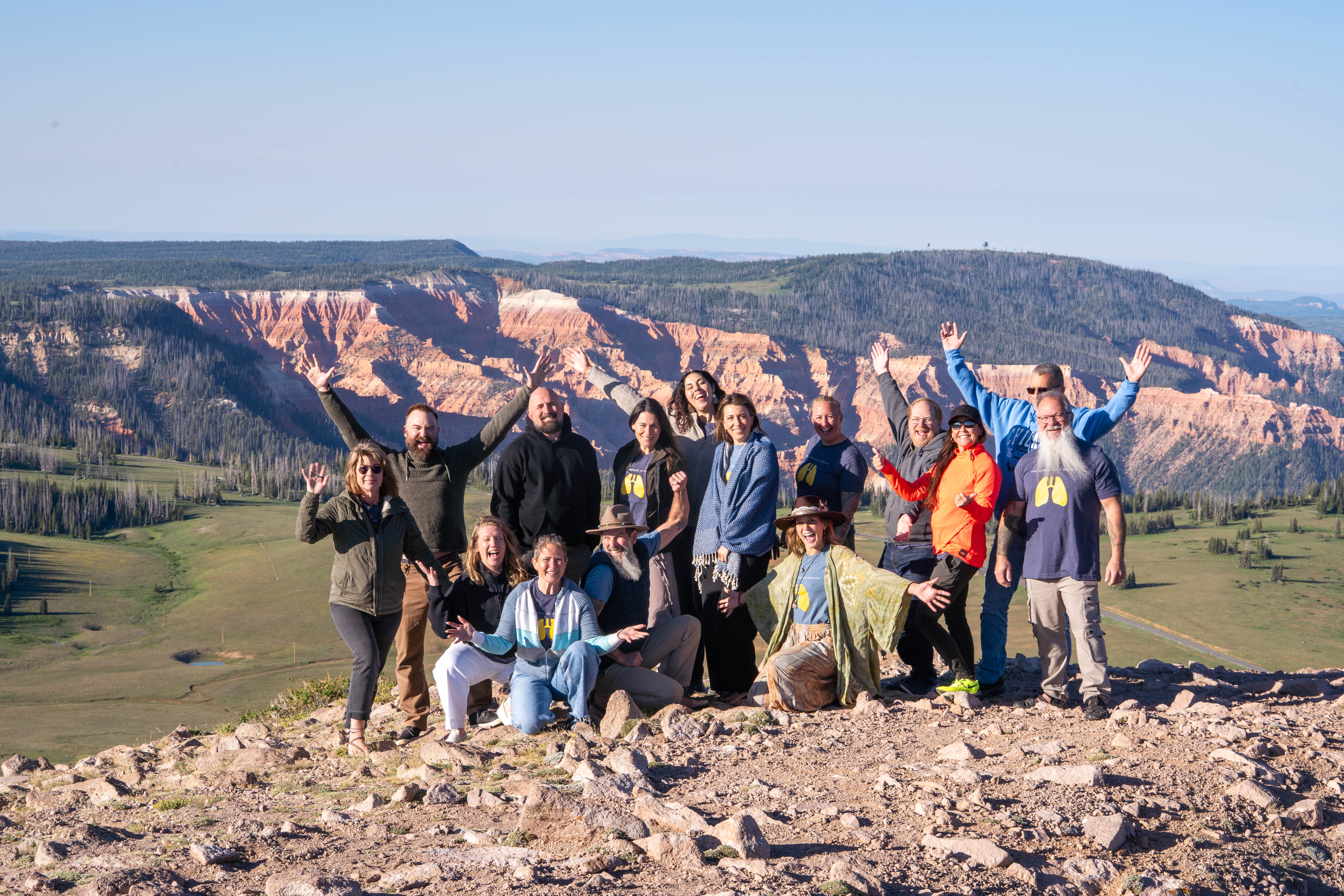
The cohort together on the rim at Cedar Breaks during the hybrid capstone week

Capstone week

You finish the hybrid track standing next to the people you trained with.

Choosing a certification

Five questions worth asking any program, including this one.

The breathwork certification market rewards confidence over rigor. These are the questions that separate the two. Ask them of us and of everyone else you are considering.

QuestionThe Language of BreathCommon in the market
Is the price published?Yes. $3,200 online, $6,200 hybridOften disclosed only on a sales call
Can you see the full curriculum before you pay?All 20 modules, in fullModule titles, or a summary
Who teaches it?Four of six faculty hold terminal degreesOne founder; named instructors unclear
Is ethics assessed, or mentioned?Graded module; contraindication screening required to passA disclaimer, or a single lesson
Is the certification complete, or level one of several?Complete. One credential, no tier above itOften tiered, with the full path costing several times the entry price

We have certified 47 practitioners, not several thousand. That is a deliberate constraint rather than a growth problem. Every graduate was observed facilitating before they were certified.

Questions

The ones people actually ask.

Do I need a clinical background to enroll?+

No. Roughly half our practitioners come from coaching, athletics or education rather than clinical work. What the training assumes is that you will be asked to justify what you do, whether by a client, a supervisor or a referring physician, and you will want an answer that holds.

How is this different from a weekend certification?+

Length is the least of it. The difference is that ethics and scope of practice are graded rather than mentioned, contraindication screening is required to pass, and nobody is certified without being observed facilitating. A weekend can teach you techniques. It cannot show anyone whether you should be trusted with them.

Can I work with clients who have trauma histories?+

Within your scope, and the training is explicit about where that ends. Trauma-informed facilitation is a required module, including how to recognize when to stop and how to refer. If you are already a licensed clinician, this extends your existing scope. If you are not, it does not create one.

Does breathwork help with chronic pain?+

It does not repair tissue, and we teach why. What is well supported is that breath influences how the nervous system processes and amplifies pain signals, along with the guarding and bracing patterns that accompany persistent pain. That is a real effect, and a narrower claim than the one usually made.

What is the difference between the online and hybrid tracks?+

The curriculum, faculty and credential are identical. The hybrid track adds a capstone week in Brian Head, Utah, with observed facilitation practice and a professional photoshoot for your practice. The online track runs its live practicums remotely instead.

Is there an affiliate program, or a tier above this one?+

No to both. There is one certification, and no revenue tier that depends on recruiting other students. That structure changes what a school optimises for, and we would rather not find out how.

What happens after I am certified?+

A full year of Residency: weekly Language Labs, monthly professional development, the music catalog, forms and the practitioner community, a listing in the public breathworker directory, and access to the practitioner community. The directory matters more than it sounds. It is how most of our graduates find their first clients.

Who this is for

Clinicians, coaches and therapists who will be asked hard questions.

If you want a marketing playbook and a set of scripts, there are cheaper certifications and they will serve you better. This one is built for people who need to defend what they do to a sceptical client, a supervisor, or a referring physician.